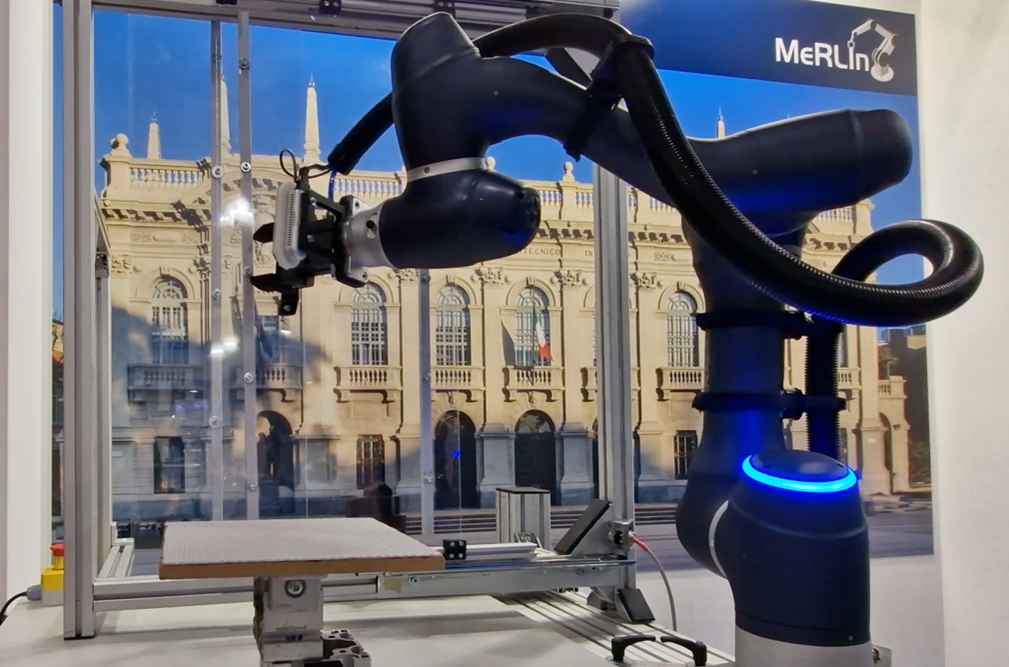
The Master’s Degree in Automation and Control Engineering at Politecnico di Milano enhances its robotics curriculum through a coherent and cutting-edge educational offering, guiding students from a solid mastery of fundamentals to the most innovative applications in industrial and medical contexts. The foundational course Control of Robotic Manipulators introduces advanced methodologies for the control of industrial robots, including kinematic and dynamic modeling, motion planning, interaction with the environment, and vision-based control, with a strong practical orientation supported by simulation software and offline programming tools. Building on these foundations, several advanced courses are offered. Collaborative, Intelligent and Humanoid Robotics explores modern robotics in scenarios involving human–robot interaction, safety, machine learning, and humanoid robots. Medical Robotics provides interdisciplinary skills related to surgical and interventional robotic systems, medical imaging, human–robot interaction, as well as regulatory, ethical, and certification aspects. Finally, Robotics Laboratory delivers a hands-on and system-level experience in the design, integration, and calibration of robotic solutions in real industrial environments, covering sensors and actuators, computer vision, and process synchronization.
Taken together, these courses ensure a comprehensive and competitive education, preparing engineers capable of addressing the challenges of contemporary robotics, spanning industry, healthcare, and advanced technological research. Alongside traditional and medical robotics, the Master’s Degree offers a complete track in mobile robotics, including the new course Aerial Robotics, which trains students in the design, modeling, control, and interaction of multirotor drones, with applications in inspection, monitoring, logistics, and physical interaction with the environment. The advanced mobile robotics track is completed by the courses Control of Mobile Robots, Perception, Localization and Mapping for Mobile Robots, and Multiagent Systems, which are shared with the Computer Science and Engineering program and included in the curriculum of the Master’s Degree in Automation and Control Engineering. Through these courses, students acquire theoretical and practical skills in control, state estimation, path planning, autonomous navigation, and multi-robot coordination, developing a solid preparation for both industrial and research applications in terrestrial and aerial mobile robotics.
Questo sito utilizza cookie funzionali e script esterni per migliorare la tua esperienza.